Sargassum in the Dominican Republic by Region and Month (2026)
Which coasts get seaweed, when it arrives, which beaches stay clear, and what to do if your trip lands in a bad week
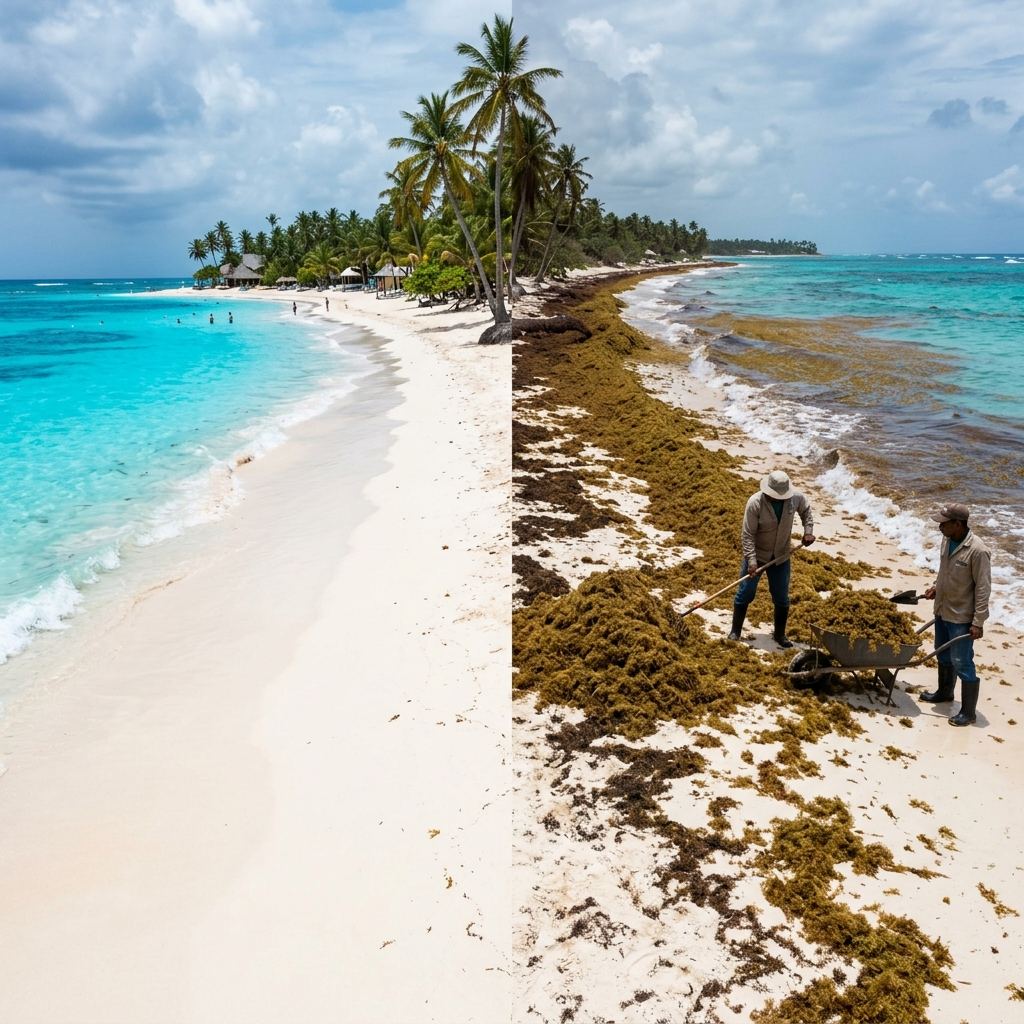
Sargassum is the subject most Caribbean travel content avoids, and the one travelers ask about most. Here is the useful version: it is a real factor from late spring to early autumn, it varies a lot from year to year, and in the Dominican Republic it depends heavily on which coast you are on. The country has beaches facing the open Atlantic to the east, the Caribbean to the south and the Atlantic again to the north, and they do not all get the same seaweed at the same time.
The short version: Sargassum is a brown floating seaweed that can wash up from roughly May to September, with the worst weeks usually June to August. Punta Cana’s east-facing beaches get the most. Bayahíbe, Miches and Montecristi usually get much less, and the north and south coasts sit in between. From November to March, beaches on every coast are almost always clear. Resorts clean their frontage every morning, and a bad week is rarely a trip-killer.
What Sargassum Is
Sargassum is a brown macroalgae that floats in huge rafts across the Atlantic. Two species (Sargassum natans and Sargassum fluitans) form what is called the Great Atlantic Sargassum Belt, which has grown sharply since 2011, linked to warmer water and more nutrient runoff into the ocean.
The rafts drift on currents and trade winds, which blow mostly from the east. When conditions push them toward the Caribbean, they pile up on beaches that face into that drift. That is why the Dominican Republic’s eastern tip catches the most, and why beaches that face south or sit inside a bay usually catch less.
It is not pollution in the trash sense. It is a natural organism showing up in unusual quantities.
The National Pattern by Month
The timing is similar across the country. What changes by region is how much arrives.
| Months | What to expect |
|---|---|
| November to March | Reliably clear on every coast. |
| April | First arrivals in some years, mostly trace amounts on exposed east-facing beaches. |
| May | Can start in real volume on the east coast; light elsewhere. |
| June to August | Peak risk everywhere. Heavy weeks are possible on the east coast; other coasts see occasional spells in heavy years. |
| September to October | Often still active, thinning through October. Boca Chica had a bad spell in September 2025. |
Year to year, the swing is large. Some summers are mild almost everywhere; others bring weeks of heavy seaweed. The practical strategy is to check conditions one to two weeks before you travel.
Sargassum by Region
Ranked roughly from most exposed to least, based on how each coast faces the drift and on what the regional guides report.
Punta Cana and Bávaro: most exposed
The east coast faces straight into the Atlantic drift, so it gets the most seaweed in the country.
Most affected:
- Macao Beach: wide-open Atlantic exposure, often heavy in season.
- Bávaro Beach: the main resort strip, moderate to heavy in peak weeks.
- Uvero Alto Beach: east-facing, with similar exposure to Bávaro.
- Arena Gorda Beach: part of the same long east-facing stretch.
Less affected:
- Juanillo Beach in Cap Cana: the most reliably clear beach in the area. The curve of the bay shields it.
- Cabeza de Toro Beach: more protected than Bávaro proper.
If you are booking Punta Cana between May and September and beach quality matters, a Cap Cana resort such as Sanctuary Cap Cana gives you much better odds than central Bávaro. Same flight, same all-inclusive model.
Miches and Costa Esmeralda: much less
The Miches coast faces north and north-west into Samaná Bay rather than east into the open Atlantic, so in most years it catches far less of the seaweed that drifts in between roughly March and October. Playa Esmeralda, where the big new resorts sit, is the main beneficiary. More exposed beaches such as Playa Limón further east see some.
This is the strongest summer argument for Miches: it is about 1.5 hours from Punta Cana airport (PUJ), and on a heavy seaweed week it can look like a different country. See the Miches travel guide.
La Romana and Bayahíbe: much less
The south-east faces the Caribbean Sea, not the Atlantic, so seaweed arrives less often than in Punta Cana. In heavy years some still reaches exposed shores between late spring and early autumn. The resort beaches on Playa Dominicus and Bayahíbe Beach are usually cleaned each morning, and sheltered Minitas Beach at Casa de Campo rarely sees much.
Bayahíbe is also the departure point for Isla Saona and Isla Catalina, so even Punta Cana guests can spend a summer beach day on this coast. More in the La Romana and Bayahíbe guide.
Santo Domingo, Boca Chica and Juan Dolio: some summers
The south coast near the capital is less exposed than Punta Cana in most years, but heavy seasons do reach it. Boca Chica Beach had serious accumulations in 2023 and in September 2025, when local press also reported seaweed at Playa Guayacanes. Juan Dolio Beach sits on the same stretch. Check recent local news or photos before a summer day trip; our beaches near Santo Domingo guide has the options.
Samaná Peninsula: occasional, mostly on the Atlantic side
North-facing Atlantic beaches on the peninsula, such as Playa Cosón, Playa El Valle and Playa Morón, can get seaweed in heavy years, usually less than Punta Cana’s east coast. Spots inside Samaná Bay, like Cayo Levantado, and sheltered coves such as La Playita are generally less affected. Summer is also when Samaná’s Atlantic beaches tend to be calmest, which partly offsets the seaweed risk. See the Samaná travel guide.
Puerto Plata, Sosúa and Cabarete: some summers
Seaweed drifts reach the north coast in some summers, generally less than the east coast. Sheltered bays such as Sosúa Beach and Playa Caletón in Río San Juan tend to be less affected than open beaches like Playa Dorada or Cabarete Beach, and resorts rake their frontage each morning. See the Puerto Plata travel guide.
Montecristi and Punta Rucia: rarely reported
The far north-west can receive seaweed in heavy years, mostly between April and September, but there are far fewer reports of it here than on the east coast. The bigger planning factors are wind and weekend crowds. See the Montecristi and Punta Rucia guide.
Barahona and Pedernales: usually less
The south-west usually sees less sargassum than the east coast. Many of the beaches people drive here for, like the river-fed Playa San Rafael and the long sweep of Bahía de las Águilas, are less about resort-style swimming anyway, and there are no resorts to clean the sand. See the Barahona and Pedernales road trip guide.
Region-by-Month Cheat Sheet
A rough guide to relative risk in a typical year. In a heavy year, move every summer cell up a level.
| Region | Nov to Mar | Apr to May | Jun to Aug | Sep to Oct |
|---|---|---|---|---|
| Punta Cana and Bávaro | Clear | Low to moderate | High | Moderate |
| Cap Cana (Juanillo) | Clear | Low | Low to moderate | Low |
| Miches | Clear | Low | Low | Low |
| La Romana and Bayahíbe | Clear | Low | Low to moderate | Low |
| Santo Domingo coast | Clear | Low | Moderate in heavy years | Moderate in heavy years |
| Samaná (Atlantic side) | Clear | Low | Low to moderate | Low |
| Puerto Plata coast | Clear | Low | Low to moderate | Low |
| Montecristi | Clear | Low | Low | Low |
| Barahona and Pedernales | Clear | Low | Low | Low |
How Resorts Handle It
Resorts on every coast use the same tools:
- Daily cleanup before dawn. Tractors and crews clear washed-up seaweed before guests are out. This works well for moderate amounts.
- Floating offshore barriers. Some resorts install booms that steer drifting seaweed away from their beach. Sanctuary Cap Cana and a few other premium properties do this.
- Extra cleanups in heavy weeks. Several passes a day during severe events.
- Guest updates. Better resorts tell guests about conditions and move beach setups or pause water sports.
Resort tier matters. Newer and higher-end properties usually invest more in cleanup than older mid-range ones. Public beaches with no hotel behind them, which are common in Samaná, Barahona and Montecristi, are cleaned less often.
What a Heavy Week Actually Looks Like
Worst case, you arrive during a peak week on an exposed beach. That usually means:
- Brown seaweed along part of the beach in the morning
- Visible seaweed in the water near shore, clearer further out
- A smell from decomposing piles in some sections
- Cleanup crews working through the day
- Public stretches worse than cleaned resort frontage
What it does not usually mean:
- Every beach equally affected
- Pools and resort facilities closed (they are fine)
- Excursions cancelled (catamarans and island boats go where the water is clear)
What to Do If Your Trip Lands in Heavy Sargassum
Switch beaches
In Punta Cana, a day at Juanillo Beach in Cap Cana is the easy fix. All beaches in the Dominican Republic are public by law, and an Uber from Bávaro was around $15 to $25 in 2026. On the north coast, try Sosúa Beach or Playa Caletón. In Samaná, take the boat to Cayo Levantado.
Change coasts for a day
From Punta Cana, Bayahíbe is about an hour to an hour and a quarter away and Miches about 1.5 hours. A Saona Island day trip or a visit to Montaña Redonda and Playa Limón puts you on a different stretch of water.
Go offshore
Catamaran cruises, island trips and snorkeling boats head out where the water is clear. Two or three excursion days can stand in for beach time.
Lean on the pool and spa
Resort pools are unaffected. If the trip was meant to be relaxing, a spa day is a good use of a bad beach morning.
Adjust expectations
A week with three great beach days and four pool and excursion days is still a very good Caribbean trip.
Health and Safety
The seaweed is not harmful to skin or to swim through. Decomposition is the issue:
- Hydrogen sulfide gas forms as sargassum rots and smells like rotten eggs.
- Brief exposure is harmless for healthy people.
- Long exposure next to a large pile can irritate eyes and airways.
- People with asthma or respiratory conditions should avoid lingering near decomposing piles.
The simple fix: do not set up next to big washed-up piles. See our safety guide for the bigger ocean risks, which are currents and surf.
Where to Check Conditions Before You Travel
- The University of South Florida’s sargassum monitoring provides satellite tracking and monthly outlooks for the Caribbean.
- Recent Tripadvisor and Google reviews for your resort or beach, sorted by newest.
- Social media searches such as “Bávaro sargazo” or “Boca Chica sargazo” (sargazo is the Spanish word), which often turn up same-week photos.
- Your resort’s own channels during peak season.
- Your travel agent or tour operator, if you booked through one.
Check one to two weeks before you fly; conditions change quickly.
Should Sargassum Change Your Plans?
Traveling November to March
Do not worry about it. Choose your region for everything else.
Traveling May to September
If beach quality is the priority, pick a less exposed region or beach: Bayahíbe, Dominicus, Miches, or Cap Cana within Punta Cana. If you want the north coast, base yourself near a sheltered bay like Sosúa.
Already booked central Bávaro for July
Resort cleanup is effective, and Juanillo, Bayahíbe and Miches are all within reach for a day. Plan excursions and pool time and the trip will be fine.
Cancelling over a forecast
Rarely the right move, and travel insurance does not usually cover it. Flexibility within the trip works better than cancelling.
Common Mistakes
- Booking an east-facing Bávaro resort for July without thinking about seaweed. Cap Cana, Bayahíbe or Miches are better summer bets.
- Assuming the whole country has the same conditions. A bad week in Bávaro can be a clear week in Bayahíbe.
- Setting up next to decomposing piles. Move along the beach.
- Trusting a “seaweed-free year” headline. It varies; plan for the possibility.
- Cancelling a non-refundable booking. Mid-trip changes almost always work.
Final Verdict
Sargassum is real and manageable. The best protection is to travel between November and March, when every coast is clear. Next best, in summer, choose a coast that faces away from the drift: the Caribbean side at Bayahíbe, the Samaná Bay side at Miches, or sheltered Juanillo in Cap Cana. And build some flexibility into the trip so you can switch beaches or head offshore if a bad week hits.
For wider planning, see the best time to visit guide, the first-timer’s guide and the safety guide.
Frequently Asked Questions
When is sargassum worst in the Dominican Republic?
Across the country, the seaweed season runs roughly from late April or May to September or October, with the heaviest weeks usually in June, July and August. From November to March, beaches on every coast are almost always clear. The amount changes a lot from year to year, so a heavy summer can be followed by a light one.
Which part of the Dominican Republic gets the most sargassum?
The east coast around Punta Cana and Bávaro, because its beaches face the open Atlantic where the seaweed drifts in. Macao, Bávaro and Uvero Alto are the most exposed. The Caribbean-facing south-east (Bayahíbe and Dominicus), the north-facing Miches coast on Samaná Bay, and the far north-west around Montecristi usually see much less.
Where should I go to avoid sargassum in summer?
Bayahíbe and Playa Dominicus on the Caribbean side, the Miches resorts on Playa Esmeralda, and Juanillo Beach in Cap Cana are the most reliable choices in the east. On the north coast, sheltered bays such as Sosúa Beach and Playa Caletón tend to be less affected. No beach is guaranteed clear in a heavy year, so check recent photos one to two weeks before you travel.
Does Samaná or Puerto Plata get sargassum?
Sometimes. North-facing Atlantic beaches on the Samaná Peninsula and the Puerto Plata coast can receive seaweed in heavy summers, but usually less than Punta Cana's east coast. Sheltered spots like Cayo Levantado inside Samaná Bay, Sosúa Beach and Playa Caletón in Río San Juan are generally less affected than open beaches.
Do the beaches near Santo Domingo get sargassum?
In some summers. Boca Chica had serious accumulations in 2023 and again in September 2025, when local press also reported seaweed at Guayacanes. Most years the south coast is less exposed than Punta Cana, but it is worth checking local news or recent photos before a summer beach day.
Is sargassum dangerous to people?
The seaweed itself is harmless to touch or swim through. The problem is decomposition: rotting piles release hydrogen sulfide gas, which smells like rotten eggs and can irritate eyes and lungs. Avoid sitting next to large decaying piles, especially if you have asthma or another respiratory condition.
Do resorts clean sargassum off their beaches?
Yes. Resorts across the country clear their beach frontage every morning, usually before guests are up, and some use floating barriers offshore. A beach that looked covered at 5pm can be clean by 8am. Public beaches without a hotel behind them are cleaned less often, if at all.
Should I cancel a trip because of sargassum?
Almost never. Even in bad years the seaweed hits some beaches and some weeks harder than others, and the Dominican Republic has coasts facing three different directions. Moving your beach days to a sheltered beach or a different coast, or booking boat trips offshore, usually saves the trip. Travel insurance does not normally treat seaweed as a covered reason to cancel.